Does a Governed SDLC Beat a One-Shot? An Isolation-Lab Study of Coding Agents
1. The lab
Every run gives three arms the identical vague one-liner and the identical model; only the context discipline differs:
- raw — one prompt, one shot. No stages, no standards, no verification.
- leaky — the same multi-stage pipeline, but every stage runs in one shared directory and receives all context unfiltered (every standard, every prior artifact). Maximal bleed.
- tight — each stage/role runs in its own directory and receives only its declared inputs plus its one governing standard. Real isolation, with feedback loops.
Everything runs headless in Docker; every deliverable is render-verified with a real browser, and cost is measured cost-faithfully (see §5).
2. Experiment 1 — Minesweeper (the null result that taught us the method)
"Build a better Minesweeper that people love."
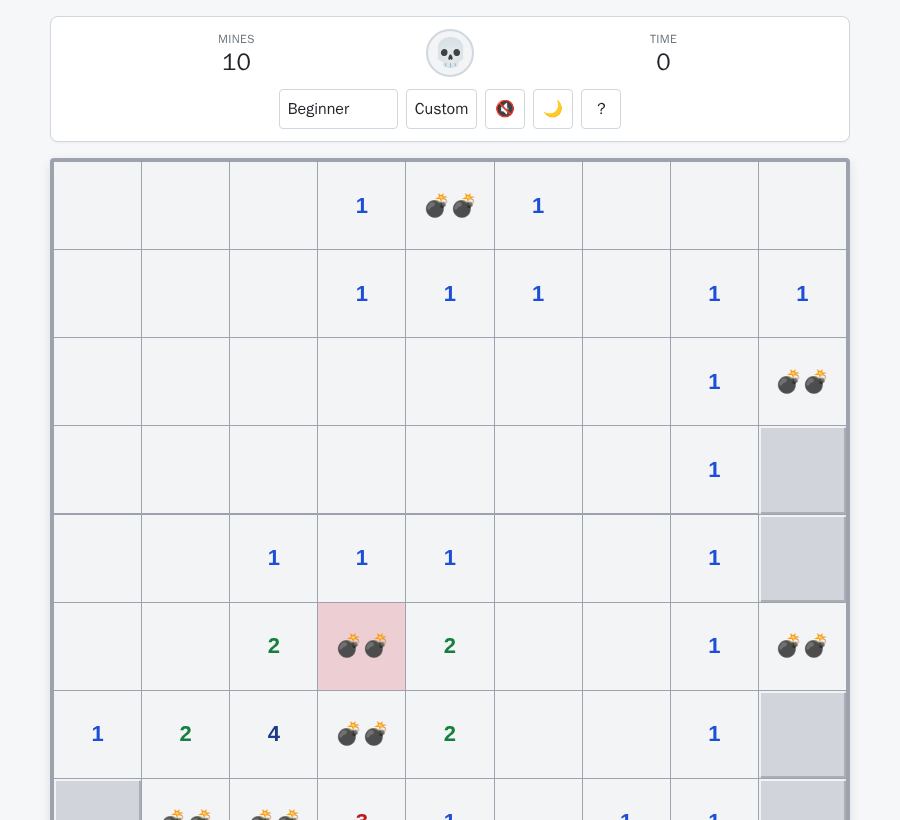
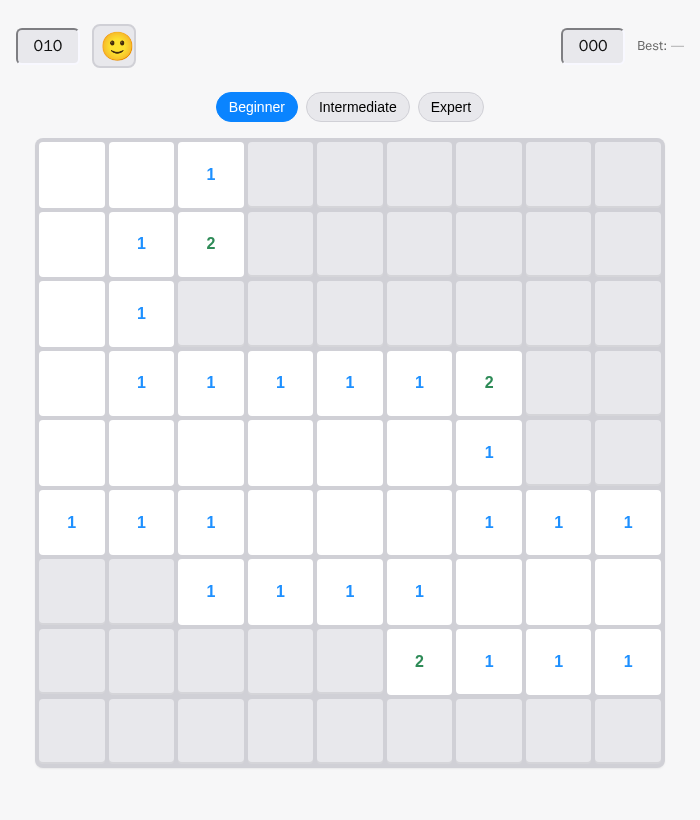
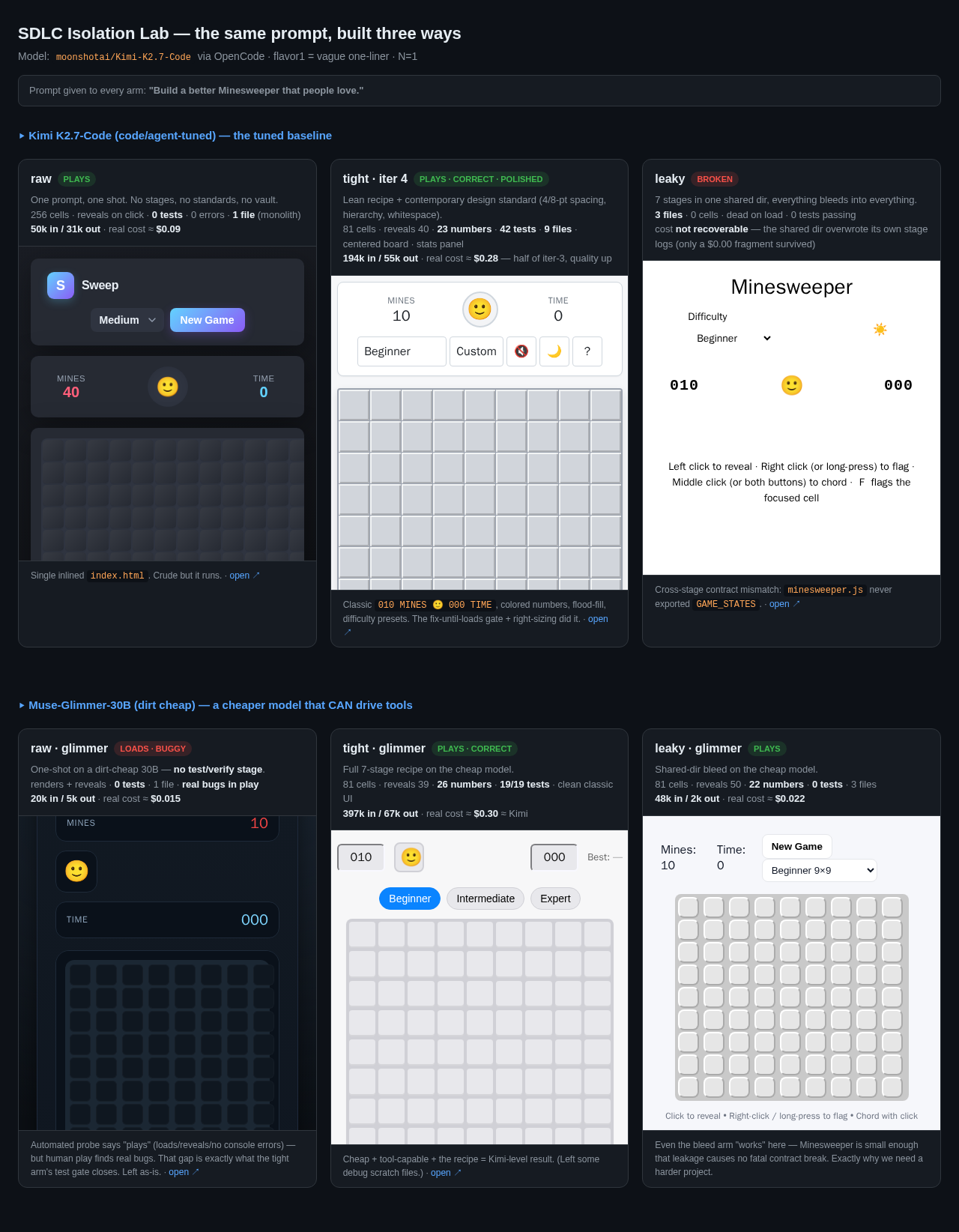
Minesweeper fits in a single context window, so a one-shot can basically hold the whole task. The arms did not cleanly separate, and that itself was the finding: process has nothing to save you from when the task is small. After several tuning iterations the tight arm produced a clean, tested game — but so did raw, most of the time.
| arm | plays? | files | tests | real cost | note |
|---|---|---|---|---|---|
| raw | yes | 1 (monolith) | 0 | ~$0.09 | high run-to-run variance |
| tight (tuned) | yes | 9 modules | 42 | ~$0.28 | polished, difficulty presets |
| leaky | no | — | — | — | cross-module export mismatch (GAME_STATES) |

2.1 The model sub-study: capability, not price, decides
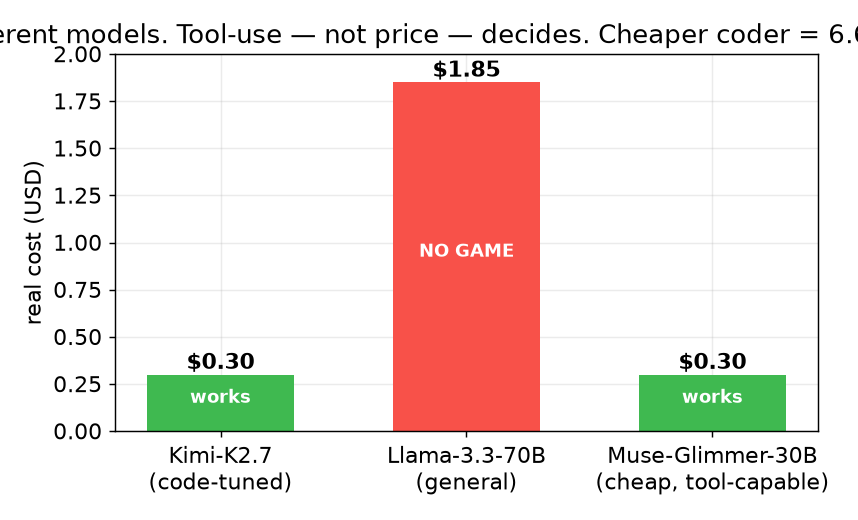
Holding the recipe fixed and swapping the model exposed a sharp rule. A cheaper but tool-capable coder (Muse-Glimmer-30B) drove the whole pipeline and shipped a working game for the same ~$0.30 as the flagship. A cheaper general-instruct model (Llama-3.3-70B) chatted instead of writing files, produced no game, and — because it got no prompt caching — cost $1.85 (6.6×) for zero output. Lesson: the recipe amplifies a model that can do agentic tool-use; it cannot rescue one that can't. "Cheaper per token" is a trap when the agentic loop can't cache.
3. Experiment 2 — A service-company invoice/quote builder (the real test)
"Build a quote-and-invoice app that a service company — like a flooring contractor — would love: measure the job, list materials with photos, add labor, produce a clean accurate invoice."
This is real software: multiple interacting subsystems, money math with edge cases (waste factor, taxable-vs-non-taxable, rounding), photos, persistence, printable output. It overflows a single shot. For this experiment the tight arm ran a full role-based pipeline (Product-Marketing → Red-Team → Designer ⇄ Design-Research → PRD → Developer ⇄ Eval), with two capped feedback loops. This is where the arms finally told the story.
| arm | outcome | LOC | files | tests | real cost | time | verdicts |
|---|---|---|---|---|---|---|---|
| raw | shiny, doesn't save | 1,914 | 15 | 0 | ~$0.15 | ~4 min | none (no eval) |
| tight | works + tested | 2,842 | 12 | 22 | ~$0.44 | ~54 min | all 3 yes |
| leaky | math ok, UX broken | 1,653 | 3 | 36 | ~$0.14 | ~12 min | — |
3.1 raw — impressive and broken
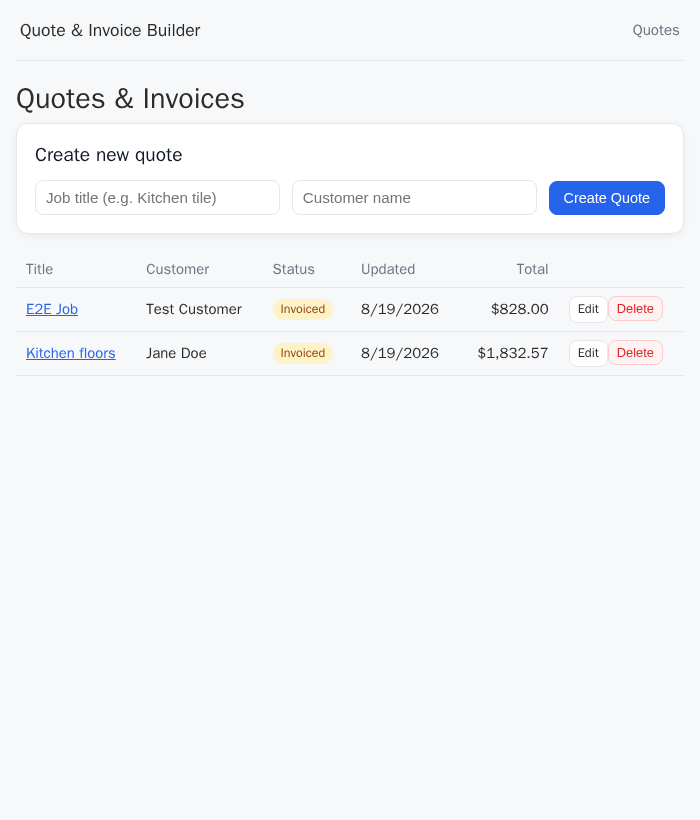
The one-shot reached for a heavyweight React + TypeScript + Express + SQLite monorepo (it needed npm install + tsc + a Vite build + a running server just to open). It renders a beautiful quotes table — and saving is broken. With no eval or test stage, nobody ever checked whether it works; it only had to look done. This is the "loads ≠ works" gap, shipped.
3.2 tight — right-sized, working, product-reasoned
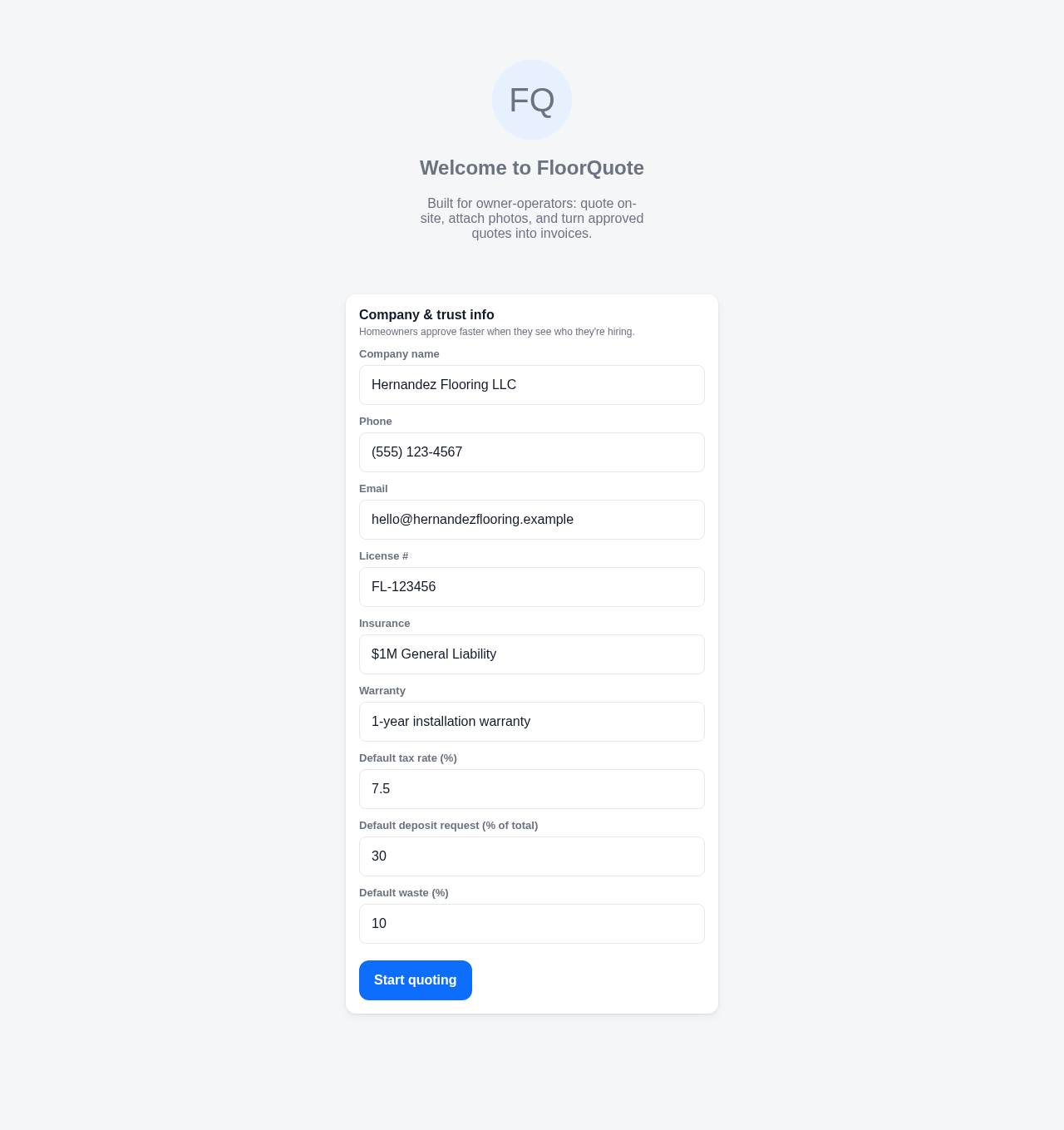
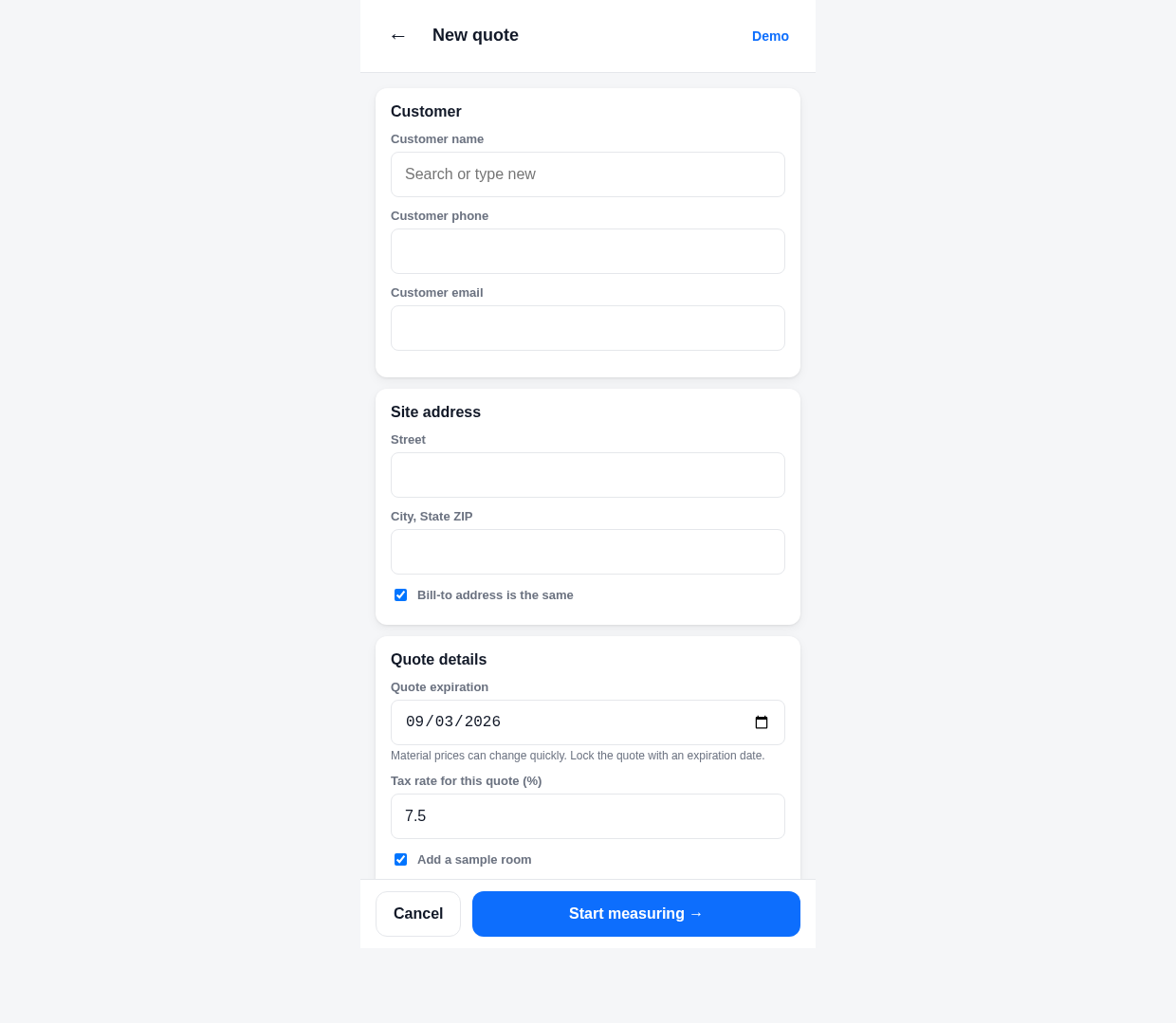
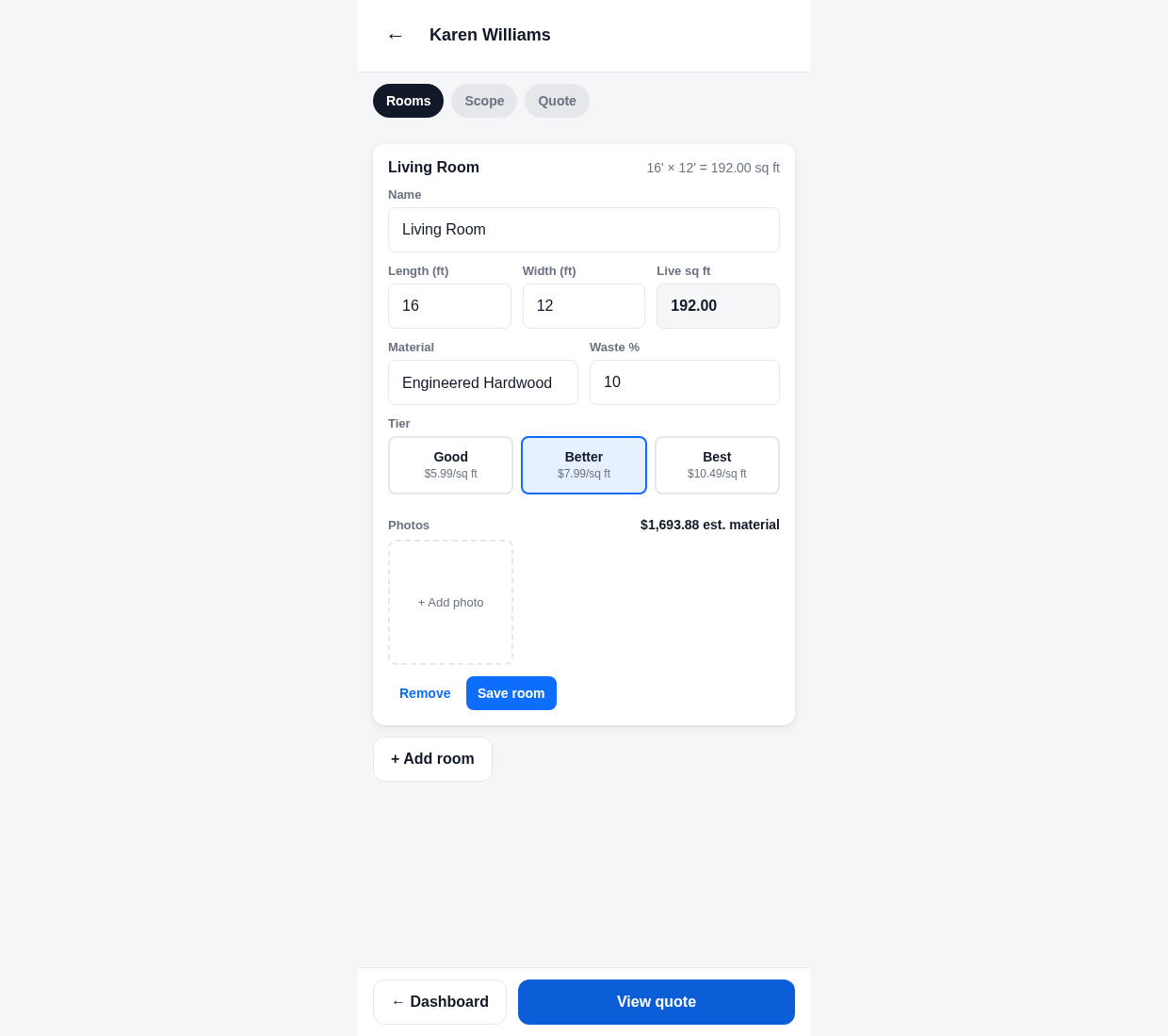
Both raw and tight correctly concluded the app must be dynamic (a real invoice tool needs a backend for photos, persistence, and shareable customer links). But tight right-sized that requirement to a zero-dependency Node server (only http/fs builtins — npm install installed nothing) plus a vanilla client. Its Product-Marketing stage surfaced a genuine insight — "homeowners approve faster when they see who they're hiring" — which became a "Company & trust info" onboarding (license #, insurance). Its eval stage started the server and ran a scripted end-to-end test (create a quote, 16'×12' room @10% waste → 212 sq ft, signature approval, price list); the Developer⇄Eval loop fired (round 1 flagged failures, round 2 fixed them, round 2 passed). Result: a working, 22-test app for ~$0.44.

A closer look at the tight build's actual screens — each one shows a product decision the governed pipeline reasoned its way to, not a default:
3.3 leaky — the bleed shows as broken UX
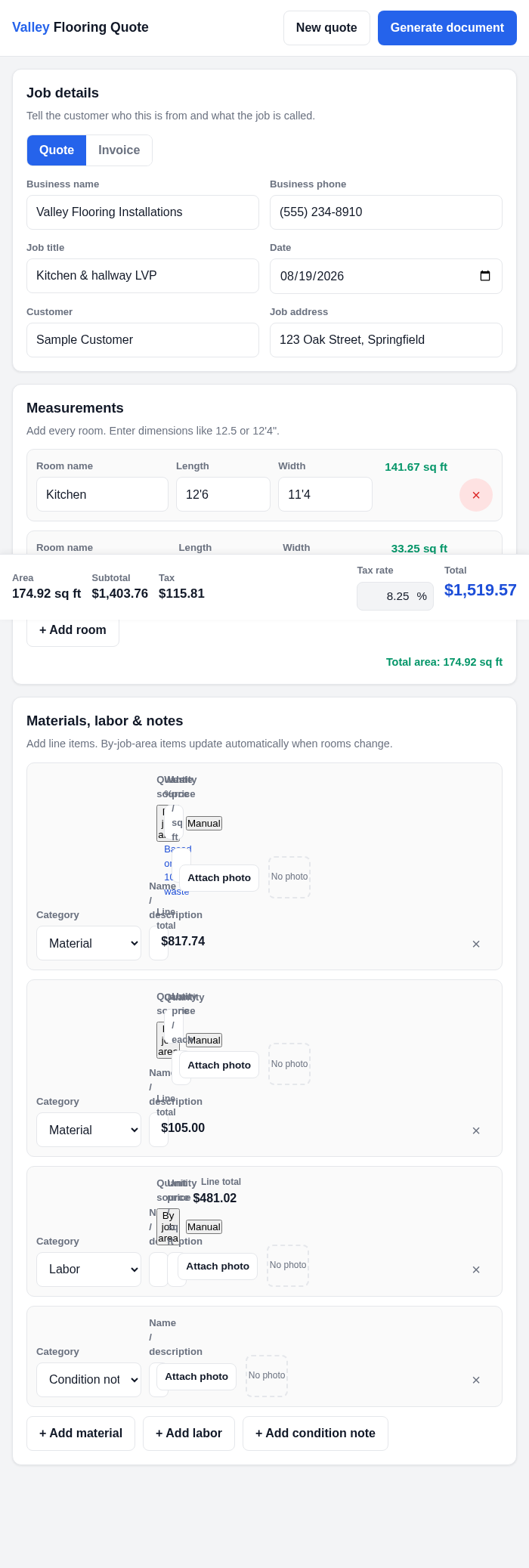
With all context in one dir, leaky produced a coherent-looking single-page app whose math is correct (174.92 sq ft → $1,519.57) but whose line-item UI is garbled — overlapping, colliding labels. Isolation is what keeps a stage's concerns from smearing into the next; without it, the surface degrades even when the logic is right. (Note: an earlier leaky run was contaminated by a harness bug that hard-coded filenames into its prompt; once fixed, the bleed still showed — as UX rot, not contamination.)
4. Empirical results
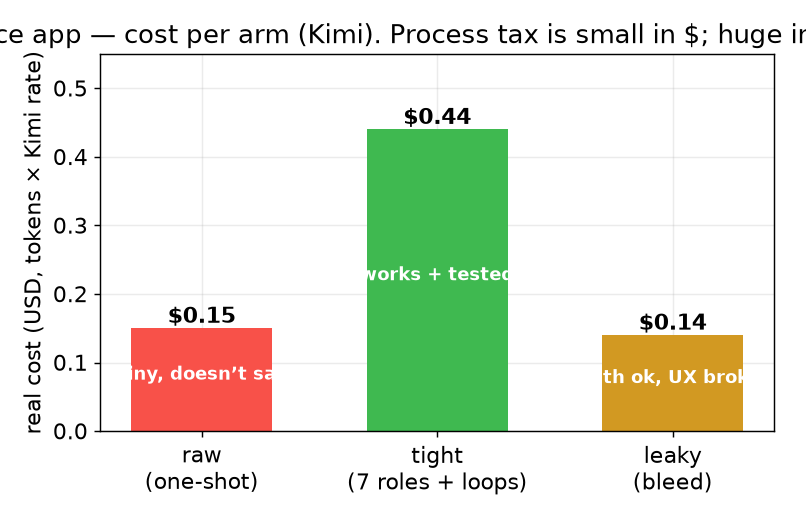
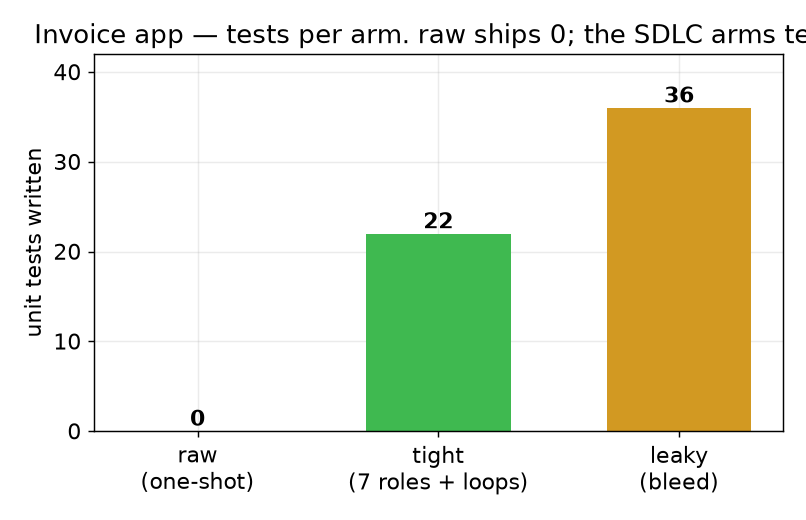
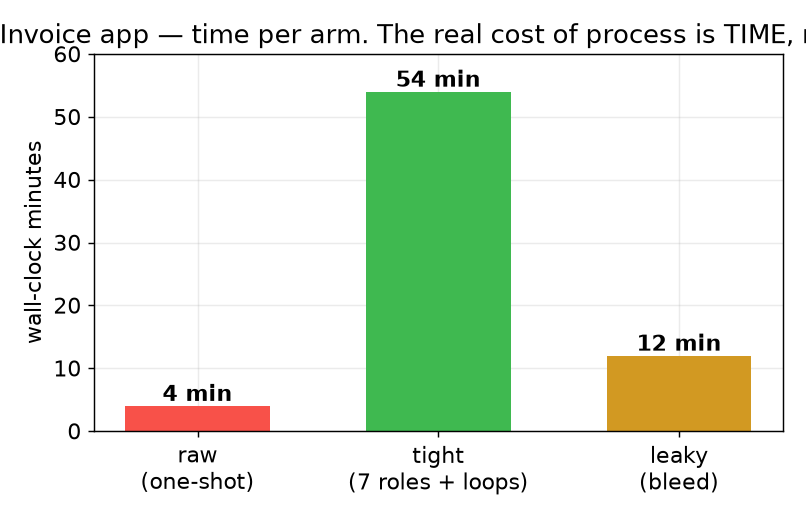
The dominant cost of the governed pipeline is time (~54 min vs ~4 min): seven roles and two feedback loops mean ~11 model calls. The dollar difference is modest (~$0.30) — small next to the quality delta (a working, tested, product-reasoned app vs a broken shiny one).
5. Principles the lab produced
tokens.total) is running context-window size — ~99% cheap cache-reads — not spend. Reporting it inflates cost 10×. Sum billable input+output (+ discounted cache) instead.6. Limitations & honest caveats
- N=1 per cell. Single draws; raw's architecture is a coin flip (across three invoice runs it built a Vite monster, a tidy static app, and a client/server monorepo — same prompt).
- tight still ships UX bugs. Its eval caught functional/save failures but over-graded polish (
DESIGN_AWESOME: yeswhile real UX bugs remained). The eval/design-research standards need to hunt UX defects specifically — a concrete next tightening. - Time cost is real. ~54 min/run makes the loop slow to iterate; caching upstream stages would help.
- Process bugs are our bugs. An early "leaky leaked Minesweeper files" claim was a harness bug (hard-coded filenames), not emergent bleed — caught and corrected. Verification discipline applies to the experimenters too.
7. Conclusion
On tasks small enough to fit one shot, skip the ceremony. On real software, a context-isolated, governed pipeline with a closing verification loop turns "looks done" into "is done" — for a modest dollar premium and a real time premium. The one-shot's ceiling is high and its floor is the floor; the process trades a little of the ceiling for a dependable floor, a paper trail, and the difference between an app that renders and an app that saves.